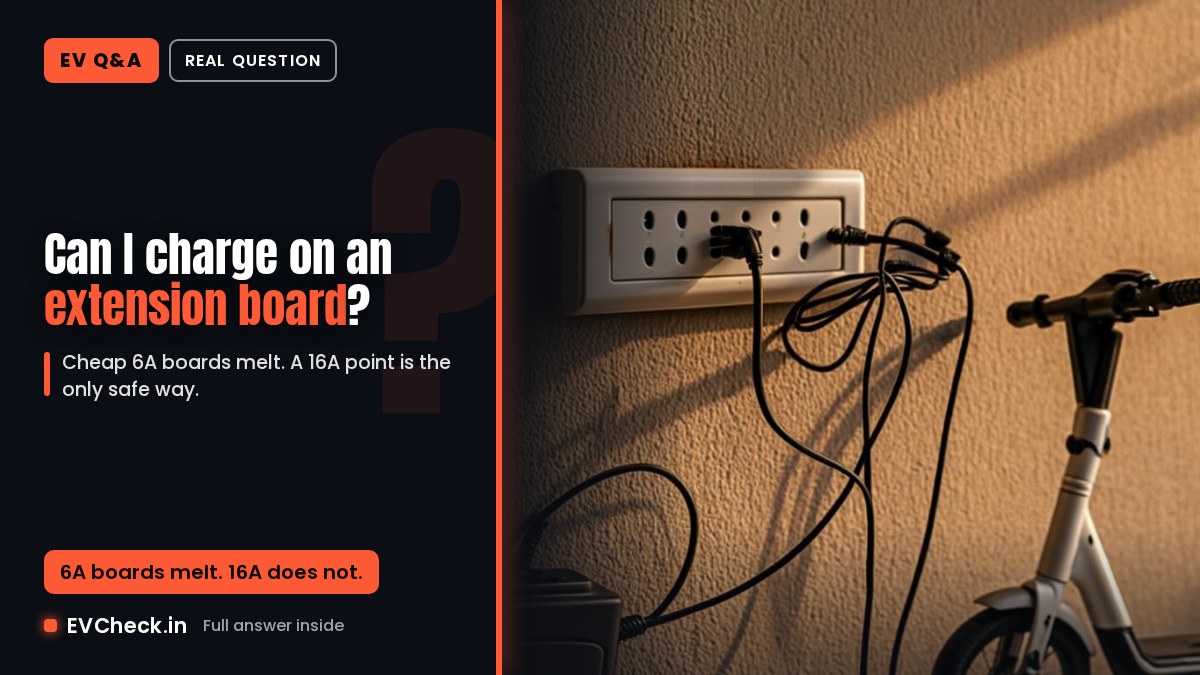
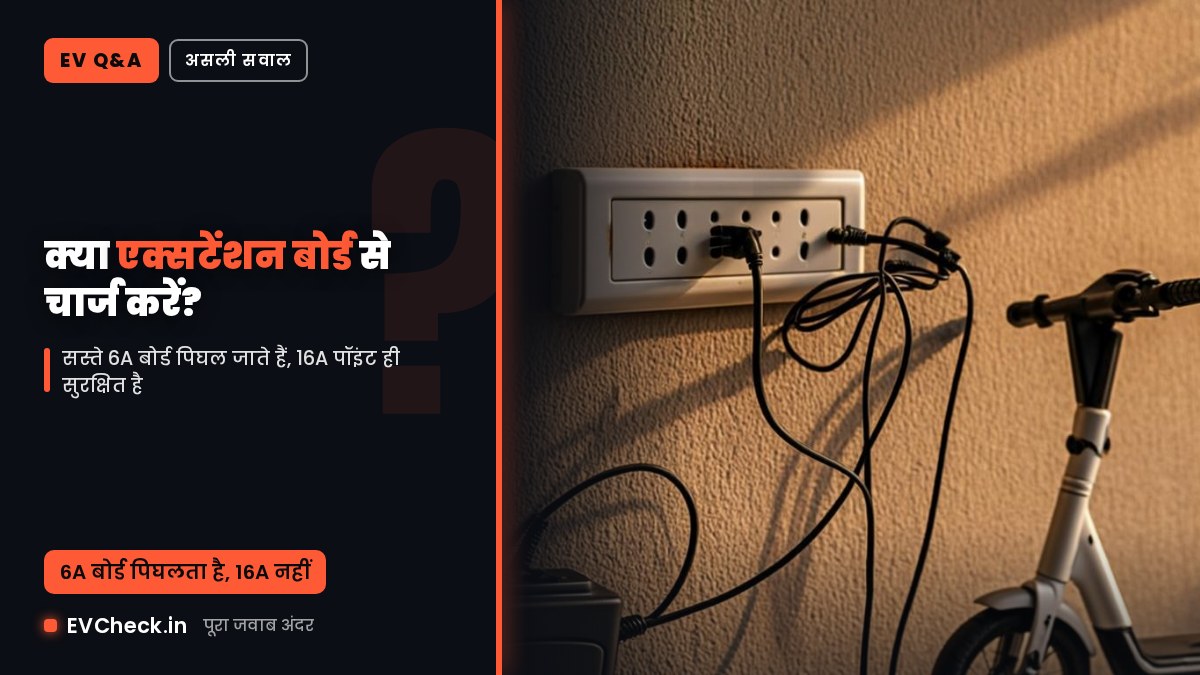
Last month an owner on r/olaelectric posted a photo that spread fast through every EV group in India: his extension board had melted around the plug pins after charging his S1 Pro daily for months. The caption was one line, “I thought 1.5 kW was fine for this board.” It was not, and his electrician confirmed the copper inside was thinner than the cable feeding it.
The 3-Second Answer
Yes, you can charge from an extension board only if it is a genuine 16A board with 2.5 sq mm copper, under 10 metres, fully uncoiled, plugged straight into the wall. The cheap 6A multi-plug boards sold at every corner shop are not that. They overheat at full load, and heat over months is what melted that plug.
The Wattage Math Nobody Does
A typical scooter charger draws 550 to 1,500 watts depending on the brand and pack size. An Ola 4 kWh charger pulls close to 1,300 watts for hours at a stretch. A standard 6A board is rated near 1,100 watts continuous, and the cheap ones use 1.0 sq mm copper that cannot even hold that. Run it for six hours nightly and the socket runs warm, the pins oxidise, resistance climbs, and one evening you get the browned, melted mess from that Reddit photo.
| Setup | Safe for nightly charging? | Why |
|---|---|---|
| Cheap 6A multi-plug board | Never | 1.0 sq mm wire, weak contacts, overheats at 1,300W |
| 6A board with other loads plugged in | Never | Total load crosses the board rating fast |
| 16A board, 2.5 sq mm, uncoiled, under 10 m | Acceptable | Holds 3,500W, heat escapes when uncoiled |
| Dedicated 16A wall point with MCB | Best | Fixed wiring, protected, what brands recommend |
What You Should Do This Week
- Feel the test: after 30 minutes of charging, touch the board body. Warm is a warning. Hot is a stop-today signal.
- Check the wire stamping: genuine 2.5 sq mm copper is printed on the cable sheath. No stamping usually means no copper worth trusting.
- Uncoil fully: a coiled cable is a heater. Every owner photo of melted boards shows a coiled loop somewhere.
- Get the 16A point: an electrician charges ₹800 to ₹2,000 for a dedicated point with MCB protection, which is nothing next to what a fire or a charger failure costs. Our home charger installation cost breakdown lists the full itemised bill.
When to Worry
- Discolouration or a burnt smell at any plug or socket.
- MCB trips that started only after you bought the scooter.
- Charger brick that clicks off and back on during sessions.
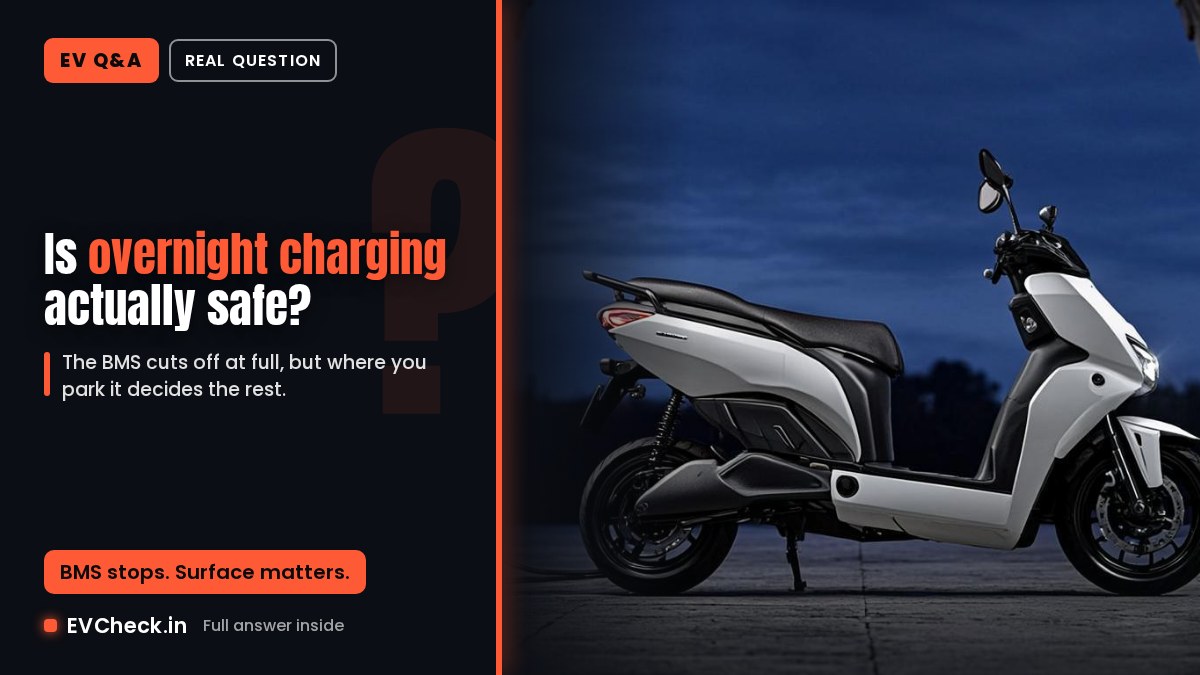
One more thing before you plug in tonight: that r/olaelectric owner now charges from a dedicated 16A point and says the board incident changed how he stores the charger too. Which raises the question half the comment section asked him next, and we answer it fully in our overnight charging safety guide, because the hours after you sleep are exactly when a bad setup gets its chance.
Which setup is charging your scooter right now? Drop the exact board or point type in the comments, we read every one and reply with the load math.