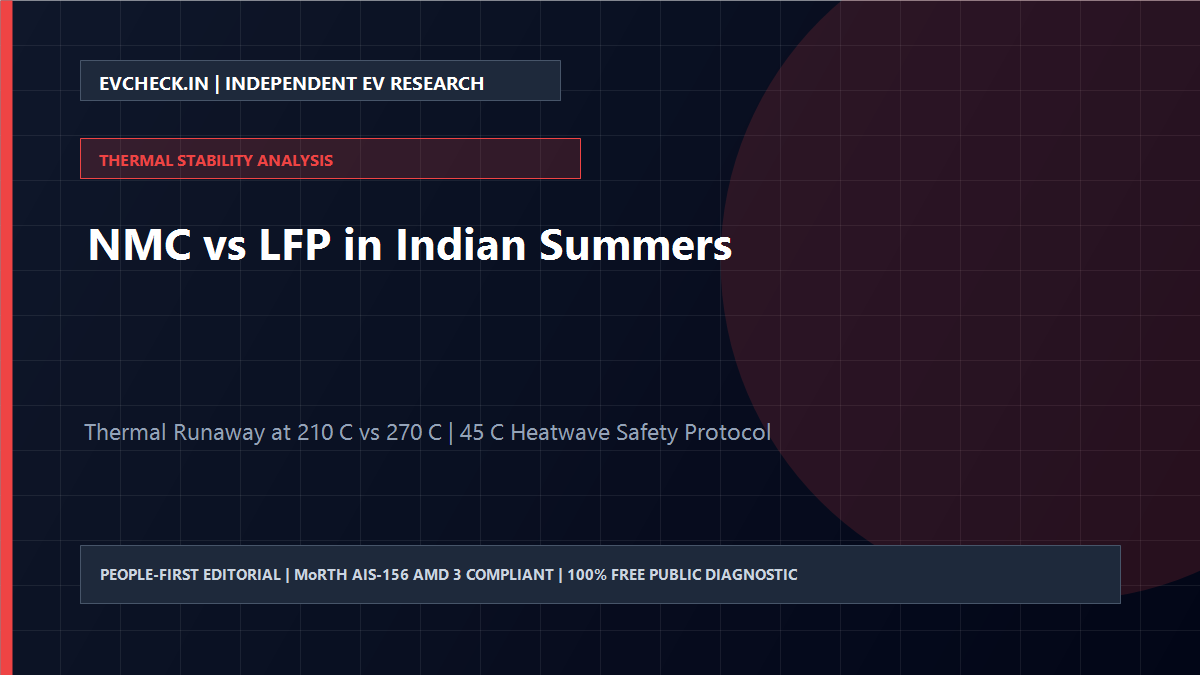
When purchasing an electric vehicle in India, the choice between NMC (Nickel Manganese Cobalt) and LFP (Lithium Iron Phosphate) cell chemistry is arguably the single most important safety and longevity decision you will make. In regions where ambient summer temperatures routinely cross 45°C and road asphalt hits 55°C, each chemistry behaves in radically different ways under thermal and electrical stress.
1. Thermal Stability & Oxygen Release Kinetics
The primary hazard during thermal runaway is not just heat, but the release of internal oxygen that fuels combustion. Here is the fundamental chemical difference:
- LFP (Lithium Iron Phosphate): LFP utilizes strong covalent phosphorus-oxygen (P-O) bonds. These bonds are exceptionally stable and do not break down until temperatures exceed 270°C. Even when an LFP cell suffers physical puncture or severe overcharging, it releases virtually no free oxygen, resulting in smoke without violent flame propagation.
- NMC (Nickel Manganese Cobalt): NMC uses layered transition metal oxides. At temperatures between 210°C and 220°C, the nickel cathode structure begins exothermic decomposition, releasing free oxygen internally. This oxygen reacts with the flammable liquid organic electrolyte, sustaining self-accelerating combustion that is difficult to extinguish with conventional fire extinguishers.
| Engineering Metric |
LFP (Lithium Iron Phosphate) |
NMC (Nickel Manganese Cobalt) |
Real-World Indian Impact |
| Thermal Runaway Onset |
~270°C |
~210°C |
LFP provides a 60°C higher safety buffer during extreme summer heat. |
| Gravimetric Energy Density |
120 – 160 Wh/kg |
200 – 280 Wh/kg |
NMC delivers ~30% more driving range for the same pack weight. |
| Usable Cycle Life (to 80% SOH) |
2,000 – 3,500 Cycles |
1,000 – 1,200 Cycles |
LFP packs typically outlive the vehicle chassis (8 to 12 years). |
| Full 100% Charge Degradation |
Very Low (Thrives on 100% charge) |
High (Degrades rapidly if kept at 100% in heat) |
NMC should be capped at 80% for daily commutes. |
| Popular Indian Vehicles |
Tata Nexon EV, Tiago EV, Punch EV, Ola S1 Air, MG Windsor EV |
Ola S1 Pro, Ather 450X, Mahindra XUV400 (early), Hyundai Ioniq 5 |
Check Position 8 of your BPAN code to identify chemistry. |
2. The Indian Summer Charging Protocol
To maximize battery life and eliminate thermal hazards between April and July, follow these four field-tested guidelines:
- Enforce the 30-Minute Post-Drive Cooldown: Never plug an EV into a DC fast-charger immediately after driving on the highway at 90 km/h in 42°C heat. Let the vehicle rest in the shade for 30 minutes so the cooling system can lower core pack temperature.
- Avoid 100% SoC Overnight Soaking on NMC: If your vehicle has an NMC pack (such as an Ola S1 Pro or Ather 450X), set your charge limit to 80% or 85% for daily city commuting. Storing high nickel cells at 100% voltage in ambient heat accelerates parasitic electrolyte decomposition.
- Top-Balance LFP Packs Weekly: Conversely, if your vehicle uses LFP (such as a Tata Nexon EV or Ola S1 Air), charge to 100% via slow 15A AC power once every 7 to 10 days so the BMS can accurately calibrate cell balancing.
- Never Charge Under Direct Sunlight: Solar radiation heating the black floorboard or bonnet can add 12°C–15°C to internal battery housing temperatures. Always charge under a covered porch or basement parking.
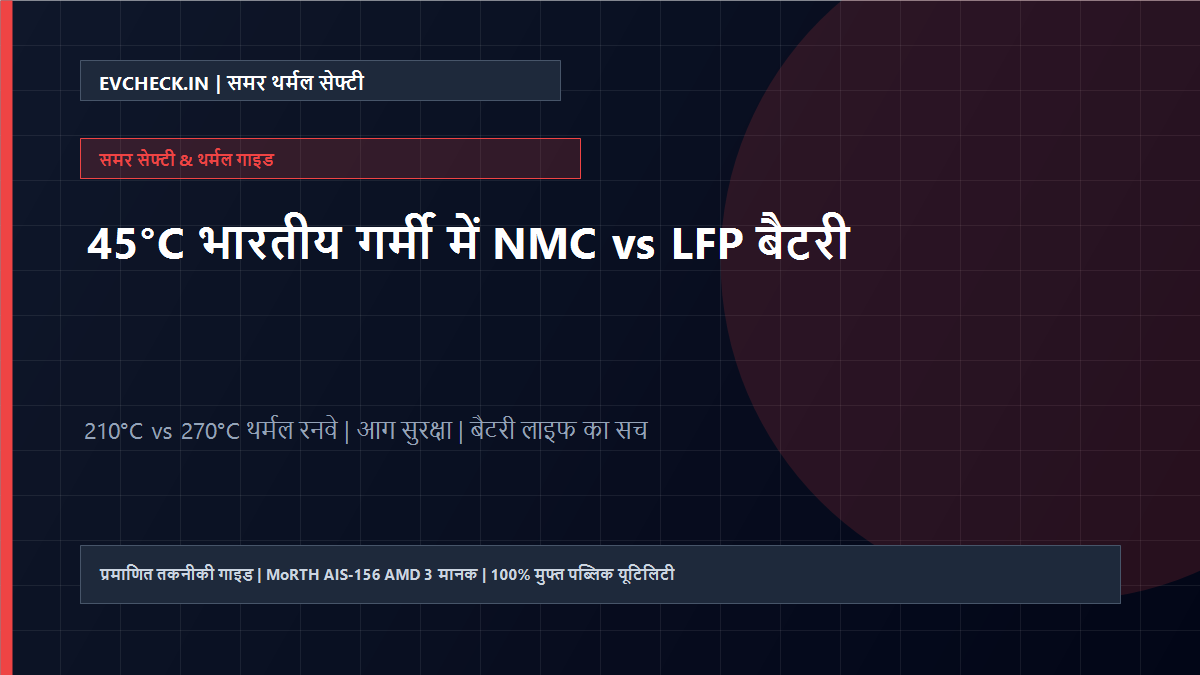
भारत में इलेक्ट्रिक गाड़ी खरीदते समय लोग केवल इस बात पर ध्यान देते हैं कि गाड़ी कितने किलोमीटर चलेगी। लेकिन दिल्ली, अहमदाबाद या हैदराबाद की 45°C वाली भीषण गर्मी में गाड़ी की रेंज से कहीं ज्यादा जरूरी यह है कि उसमें NMC बैटरी है या LFP।
1. NMC और LFP में असली फर्क क्या है?
भारतीय दोपहिया और कारों में मुख्य रूप से दो तरह की लिथियम-आयन बैटरी इस्तेमाल होती हैं:
- LFP (लिथियम आयरन फॉस्फेट): यह बहुत मजबूत और सुरक्षित केमिस्ट्री है। इसका थर्मल रनवे तापमान 270°C होता है। यह 45°C की गर्मी को आसानी से झेल लेती है। टाटा नेक्सन ईवी, टियागो ईवी और ओला एस1 जेन 2 / एस1 एक्स में यही केमिस्ट्री है।
- NMC (निकल मैंगनीज कोबाल्ट): यह हल्की होती है और ज्यादा रेंज देती है, लेकिन यह गर्मी के प्रति संवेदनशील है। 210°C पर पहुंचते ही इसमें ऑक्सीजन रिलीज होने लगती है जो आग को भड़काती है। ओला एस1 प्रो जेन 1, एथर 450X और टीवीएस आईक्यूब में NMC सेल हैं।
| मापदंड |
LFP (लिथियम आयरन फॉस्फेट) |
NMC (निकल मैंगनीज कोबाल्ट) |
| आग लगने का तापमान (Thermal Runaway) |
~270°C (अत्यधिक सुरक्षित) |
~210°C (गर्मी में संवेदनशील) |
| बैटरी लाइफ (फुल चार्ज साइकिल) |
2,500 से 3,500 साइकिल (10 से 12 साल) |
1,000 से 1,200 साइकिल (4 से 6 साल) |
| भारतीय गर्मी (45°C) सहनशीलता |
बहुत अच्छी (बिना लिक्विड कूलिंग भी स्थिर) |
सक्रिय कूलिंग की सख्त जरूरत |
| 100% चार्ज करने का नियम |
हफ्ते में एक बार 100% चार्ज जरूर करें |
रोजाना 20% से 80% के बीच रखें |
2. गर्मियों में बैटरी को आग और खराबी से बचाने के 4 नियम
- तेज धूप में कभी चार्ज न करें: 42°C धूप में खड़ी गाड़ी का फर्श 55°C तक गर्म हो जाता है। धूप में चार्ज करने पर सेल का तापमान 60°C पार कर सकता है। हमेशा छाया या बेसमेंट में चार्ज करें।
- हाईवे पर तेज चलाने के तुरंत बाद फास्ट चार्ज न लगाएं: लंबी दूरी तय करने के बाद कम से कम 20-30 मिनट रुकें ताकि बैटरी का तापमान सामान्य हो सके।
- NMC बैटरी को रोजाना 100% न करें: अगर आपके पास ओला एस1 प्रो या एथर 450X है, तो रोजमर्रा के सफर में 80% या 85% तक ही चार्ज करें। 100% पर गर्म मौसम में सेल जल्दी कमजोर होते हैं।
- LFP बैटरी को हफ्ते में एक बार धीमी गति से 100% करें: टाटा नेक्सन या ओला एस1 एयर को हर 7 से 10 दिन में 15A सॉकेट से 100% चार्ज करें ताकि सेल बैलेंसिंग ठीक रहे।