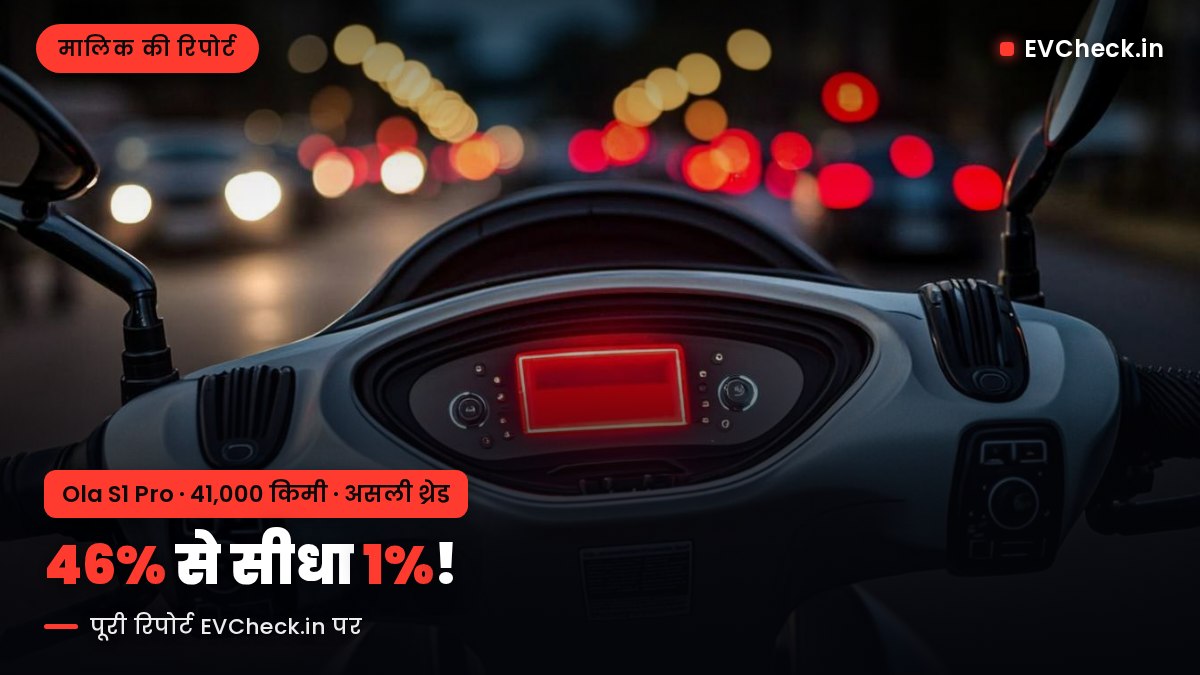
A 3.5-year-old Ola S1 Pro with 41,000 km on the clock should not lose three-quarters of its charge in one second. Yet that is exactly what an owner described on the r/olaelectric subreddit in October 2026: the meter read 46%, then flicked to 1%, and the scooter entered limp mode on a live road. The same thread pulled in dozens of replies with nearly identical stories.
Three Real Cases From Owner Threads
The pattern repeats across Reddit and owner groups with unsettling consistency. One Gen 2 S1 Pro owner wrote that after a service centre software update, the scooter now drops from 46% to 1% instantly, and he suspects either cell 11 or the BMS. Another posted that his scooter simply shut off at 35% charge, then displayed 2% and would not restart. A third reported the same behaviour at 20% remaining.
None of these owners reported a gradual range fade first, which is what normal battery ageing looks like. A sudden cliff is a different fault entirely, and that distinction matters for your wallet.
Why the Meter Lies: It Is Usually Not the Whole Pack
An EV battery pack is built from dozens of cell groups wired in series. The BMS tracks each group and estimates remaining charge from voltage plus current flow. When one group ages faster than the rest, it sags hard under acceleration load. The BMS sees that voltage dip, assumes the whole pack is nearly empty, and slams the display to 1%.
When you ease off the throttle, voltage recovers, and the meter climbs back up. That bounce-back is the signature symptom owners describe in these threads. The pack still holds most of its energy, but one weak section is fooling the gauge.
| Symptom | Likely Cause | First Fix |
|---|---|---|
| % drops instantly, recovers when parked | One weak cell group sagging under load | BMS relearn cycle, then service inspection |
| Scooter dies at 20 to 35%, restarts later | Severe imbalance or loose pack connector | Full 0 to 100% charge, then BMS log pull |
| Range fades slowly month by month | Normal calendar and cycle ageing | SOH test, plan for eventual replacement |
| Drops started right after an update | Stale SoC estimate after new firmware | One full recalibration ride cycle |
The 3-Step Triage Before You Pay for a New Pack
- Run one full recalibration: ride the scooter low (near 5%), then charge uninterrupted to 100% overnight. This lets the BMS relearn each cell group and clears false jumps in a surprising number of cases.
- Pull the BMS logs: ask the service centre in writing for the cell-level voltage report. One outlier group confirms imbalance, and that document becomes your warranty evidence.
- Check the clock: Ola packs carry warranty up to 8 years or 80,000 km. A 41,000 km scooter with a documented fault is a claim candidate, not a ₹90,000 replacement bill.
We broke down the full diagnostic path in our Ola S1 battery failure case study, and you can verify your pack age and chemistry from the label using the Ola S1 BPAN decoder.
One warning from the same threads: do not ignore the fault. A heavily imbalanced pack runs hot on the weak group every single ride. If recalibration does not hold, book the inspection, carry your records, and read the claim rules in our Ola battery warranty guide before you agree to any paid replacement.